Protecting batteries in AI racks & battery roomstwo components, one Class A loop
two relays per sensor in the rack
 Enlarge
Configuration per row of racks
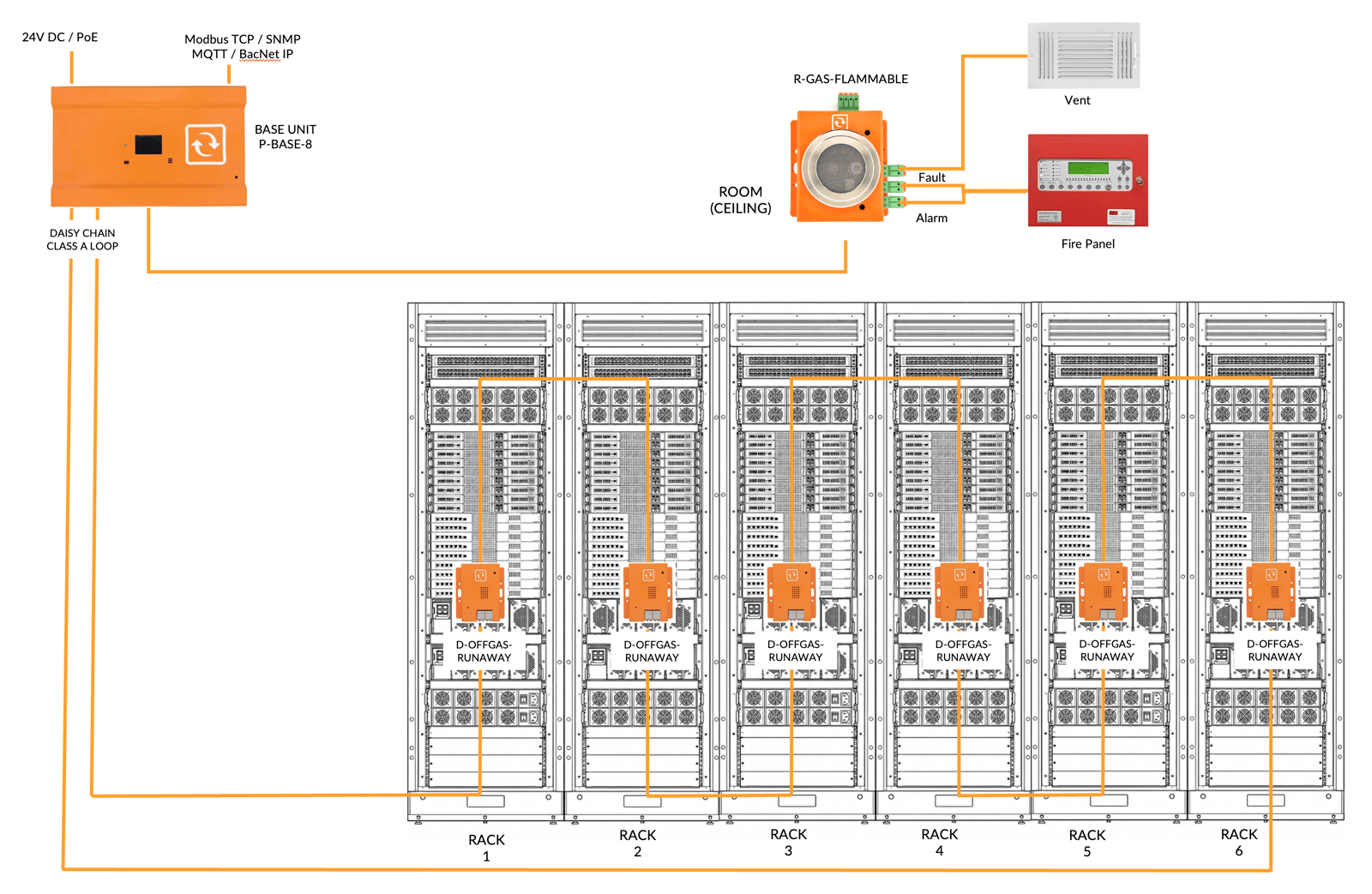
Per rackD-OFFGAS-RUNAWAY at the battery shelf of each AI rack
Per loopP-BASE-8, one Class A loop of up to 40 sensors
RoomsD-OFFGAS-RUNAWAY per battery rack, 2 on a full rack
CeilingR-GAS-FLAMMABLE in battery rooms, wired to the vent and the fire panel
R-GAS-FLAMMABLE: cULus Listed (UL) to UL 61010-1 and ETL Listed (Intertek) to UL 2075. D-OFFGAS-RUNAWAY and P-BASE-8: certification to UL standard pending.
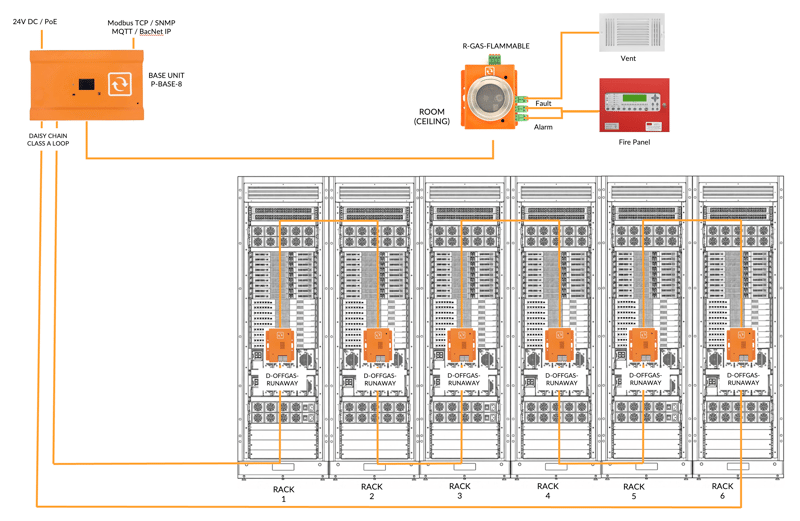
The infographic shows a possible Gen 4 installation on a row of six racks. Our Prevent-iON® partners customise the configuration to your environment based on NFPA and local code requirements. Ask your question
Previous configuration: installations on the BASE-PI-5-24V, DAISY-STARTER and DAISY-GAS-VOC remain available and supported for battery racks in battery rooms. Gen 4 sensors require a P-BASE-8.
Detection and action in the rack
why the battery moved
and why the detector had to follow it
and why the detector had to follow it
AI moved the batteries into the white space. Battery backup units now sit inside the GPU rack, typically at the bottom, to smooth the power feeding the rack and to keep the liquid cooling running when the power bus to the rack is interrupted. The rack fans push the air out of the rack into an open, climate controlled hall, so vented gas does not rise to a ceiling detector in time to tell you which rack is in trouble. Detection, and the action that follows it, has to happen in the rack.
In the rack
One D-OFFGAS-RUNAWAY per rack, at the battery shelf: discrete off-gas and thermal runaway detection, with two relays per sensor for in rack action. The decision to alarm and to act is taken in the sensor, within seconds, without a round trip to a central controller. Calibration free, with a 10 year life span.
Validated sensing
The off-gas and thermal runaway gas sensing technologies of the D-OFFGAS-RUNAWAY were validated in an independent test series run by Fire and Risk Alliance. In three releases of real LFP thermal runaway gas, both detected the gas in all three tests. See the evidence
On the loop
The sensors are daisy chained from rack to rack as a Class A loop that returns to the P-BASE-8, up to 40 sensors per loop. A single open anywhere in the loop keeps every sensor connected. The P-BASE-8 reports every reading, alarm and relay state over Modbus TCP, SNMP, MQTT and BACnet IP.
At room level
In a battery room, the R-GAS-FLAMMABLE on the ceiling is the 0 to 100% LEL detector that NFPA 855 and NFPA 69 call for to drive the ventilation. It connects to a direct probe of the same P-BASE-8 and wires its alarm and fault contacts to the vent and the fire panel.
Gen 4 against the legacy system
in rack detection, compared line by line
Components
2
legacy: 5
Sensor and P-BASE-8, against sensor, hub, switch, PC and relay module
Sensors per loop
40
legacy: 12 per hub
On one Class A loop per P-BASE-8; the legacy system has no loop
Max relays per loop
86
legacy: 16
2 per sensor and 6 on the P-BASE-8, against one relay module per controller
Thermal runaway
2
legacy: none
Dual confirmed by two independent sensing elements; the legacy system is off-gas only
Gen 4 installation on a row of six racks