Gen 4 Off-gas &
Thermal Runaway
Detection & Action for AI racks
and battery rooms
Detects lithium-ion off-gas: DEC, EMC, DMC
Discrete thermal runaway gas detection, dual confirmed.
2 embedded relays in every sensor for in rack action.
Detection and action in seconds in the sensor, no controller round trip.
Daisy chained as a Class A loop.
Up to 40 sensors on the P-BASE-8 base unit (required).
Combined thermal runaway gas, off-gas, temperature & humidity detection in one sensor.
Calibration free sensor with 10 year life span.
Sensing technology validated by Fire and Risk Alliance.
Patents pending. Certification to UL standard pending.
Modbus TCP & RTU, BACnet IP via the P-BASE-8 base unit.
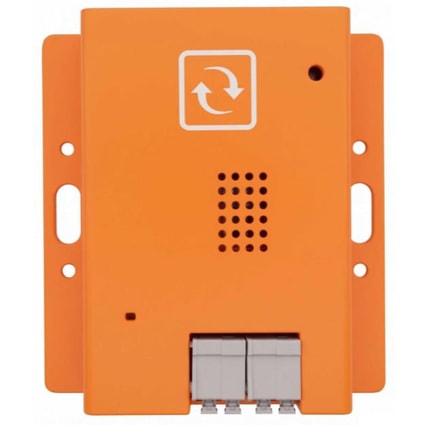
Part number: D-OFFGAS-RUNAWAY
The D-OFFGAS-RUNAWAY is available through OEM partners in select markets.
It requires the P-BASE-8 base unit and does not run on the BASE-PI-5-24V or BASE-PI-6.
It is a monitoring sensor for early off-gas and thermal runaway detection. It is not a fire detection, life safety, or suppression initiating system.
It requires the P-BASE-8 base unit and does not run on the BASE-PI-5-24V or BASE-PI-6.
It is a monitoring sensor for early off-gas and thermal runaway detection. It is not a fire detection, life safety, or suppression initiating system.
Designed for the AI Rack
Batteries now sit inside the GPU rack. Rack fans push the air out into the hall, not up to a ceiling detector, so detection and action have to happen in the rack itself.
Stage 2: Off-Gas Detection
Electrolyte vapors are released long before smoke or fire. Two gas indices, VOC and NOx, read more than one sign of a cell in distress.
Stage 3: Thermal Runaway Detection
A discrete Triggered signal, separate from the off-gas indices, when a cell goes into thermal runaway. Dual confirmed, within seconds. Off-gas only systems stop at Stage 2.
Independently Validated
Off-gas and thermal runaway gas sensing validated by Fire and Risk Alliance on real LFP thermal runaway gas. Detected in all three tests.
In Rack Action: Embedded Relays
Two relays built into every sensor, each assignable to any alarm. Isolate, signal or trigger at the rack itself, without a central relay module.
All Logic in the Sensor
Detection and relay decisions are taken in the sensor itself, not after a round trip through hubs, switches and a controller. Detection and action in seconds.
Class A Loop
Daisy chain up to 40 sensors from rack to rack as a Class A loop that returns to the P-BASE-8. A single open anywhere in the chain keeps every sensor connected. Or run one sensor standalone.
Two Components: Sensor & P-BASE-8
The sensor and the P-BASE-8 base unit. One RJ45 cable up to 100 m carries data and power. No hubs, switches, terminators or industrial PC. Previous base units are not supported.
Open Integration
The P-BASE-8 exposes readings, alarms and the thermal runaway state over SNMP, Modbus TCP and BACnet IP to the BMS, fire panel, DCIM or NMS.
In Rack & Room Level
The only platform to offer in rack and room level detection: D-OFFGAS-RUNAWAY in the rack, R-GAS-FLAMMABLE at row and room level per NFPA 855 and NFPA 69.
Sensors Per Rack
One sensor per rack as a baseline, two on a full rack of batteries to stay closer to the source. Why rate of change matters more than the absolute level.
Technical Specifications
View detection ranges, accuracy, relay ratings, cabling, environmental and physical specifications for the D-OFFGAS-RUNAWAY.
Stage 2: Off-Gas Detection
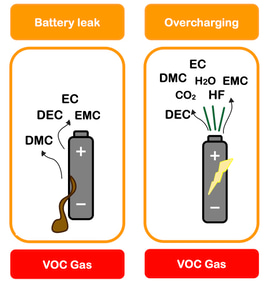 Lithium-ion cells release electrolyte vapors when they are stressed or damaged, well ahead of smoke or flame. They are the earliest reliable signal available. Detecting them allows a timely intervention, isolating or shutting down the affected rack, before the event escalates.
- Targeted chemistry: designed for the carbonate electrolyte vapors released during first venting: DMC, DEC and EMC.
- Two gas indices: the sensor reports a VOC index and a NOx index, each 0 to 500, so it reads more than one sign of a cell in distress.
- Rate of rise and absolute level: alarm on how fast the VOC index rises, on its absolute level, or both. Per rack placement keeps the trend meaningful and points to the rack that is venting.
- Self adapting baseline: the absolute level is measured against a baseline each sensor learns from its own rack, so a steady background in the hall reads as normal. Background compensation sits in every sensor, without separate reference sensors.
- Validated sensing technology: the off-gas sensing technology was validated in an independent test series run by Fire and Risk Alliance. In three releases of real LFP thermal runaway gas, it detected the gas in all three tests.
- Environment included: temperature and relative humidity are measured in the same sensor.
- Stage 2 is where Gen 4 starts: off-gas detection is the first warning. Thermal runaway detection, the second and distinct signal, is what sets the D-OFFGAS-RUNAWAY apart.
Class A Loop: Daisy Chained or Standalone
The D-OFFGAS-RUNAWAY runs on the P-BASE-8 base unit in two configurations. Both use the same sensor and report the same measurements. They differ only in how the sensors are wired into the installation.
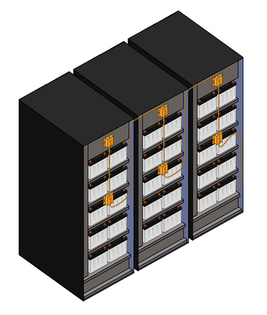
Daisy Chained as a Class A Loop
- Up to 40 sensors are linked from IN to OUT, one to the next, and the chain returns to the P-BASE-8 through its daisy start and daisy feedback ports. Both ends of the loop are connected.
- A single open anywhere in the loop, a pulled patch cable, a damaged run, keeps every sensor connected and reporting. This is the Class A circuit fire engineers expect from NFPA 72.
- Terminated chains, Class B, end at a terminator plug. One open cuts off every sensor beyond it. Off-gas only systems are wired that way.
- A row of racks is covered with one loop instead of one cable run per rack, which substantially reduces cabling, port count and installation time in the white space, in multi rack battery rooms and in containerised installations.
Standalone
- One sensor connected directly to a port on the P-BASE-8.
- One cable run per sensor: the simplest option for a single cabinet, a small rack count, or a retrofit where cable routing is already in place.
- Plug and play: the base unit recognises the sensor on connection, no configuration required.
Which one? Choose standalone when sensors are few and spread out; choose the Class A loop when covering a row of racks, where fault tolerance and the saving on cable runs and base unit ports both matter. Either way, the P-BASE-8 is required: previous base units have no daisy feedback port.
In Rack & Room Level Detection
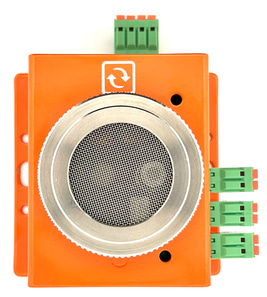 In rack detection tells you which rack is in trouble. Room level detection tells you when the room itself is becoming hazardous. Prevent-iON® is the only platform to offer both.
- In the rack: D-OFFGAS-RUNAWAY, off-gas and thermal runaway detection, with two relays for local action.
- Row and room level: R-GAS-FLAMMABLE, off-gas and flammable gas detection, ETL Listed to UL 2075, as required by NFPA 855 and NFPA 69.
- One platform, one integration: both sensors report over the same open protocols, so the BMS, fire panel and DCIM see one system, not two.
Deployment Guidance
For effective coverage, install one D-OFFGAS-RUNAWAY sensor per battery rack. On a full rack of batteries, two sensors per rack are recommended so that a sensor is always close to the source of the venting event.
- Proximity to the source: off-gas disperses and dilutes as it travels. On a fully populated rack, a single sensor can be several cells away from the one that vents. A second sensor keeps the detection point close to wherever the event starts, top or bottom of the rack.
- Rate of change over absolute level: a rising VOC or NOx index is far more informative than any single reading. Per rack placement is what makes that trend meaningful. A shared sensor covering several racks dilutes the signal and delays detection.
- Localisation and action: per rack sensors identify which rack is venting, not just that something in the room is, and the relays act on that rack.
- Cabling: the Class A loop is designed for exactly this density: a row of racks, two sensors each, on one loop back to the P-BASE-8, with no sensor lost to a single open.
- In an AI rack: mount at the battery shelf, typically towards the bottom of the rack, where the battery backup units sit.
- Placement: mount where vented gases will accumulate, following the airflow of the cabinet or enclosure.