The Mixture CriterionWhat the code asks a detector to measure
and what live LFP off-gas testing showed
NFPA 69 requires combustible concentration reduction: the flammable mixture kept below 25% of its LFL
SFPE framework: gas composition is an engineering deliverable, not a datasheet footnote
Measured: live LFP off-gas testing by Fire & Risk Alliance · Report 1184-001
The Requirement
Of the mixture present, not of a nominated reference gas
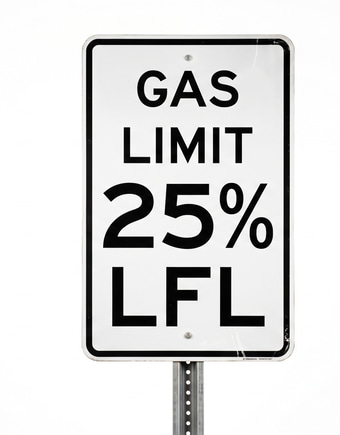
Combustible concentration reduction under NFPA 69 requires the concentration of flammable gas to be maintained below 25% of the lower flammable limit. The limit applies to the flammable gas mixture present, not to a nominated reference gas. NFPA 855 (2026) carries this into the detection requirement itself: the gas detection system is to activate on the mixture threshold.
Why it is hard to satisfy. Lithium-ion vent gas is a mixture whose composition varies with chemistry, state of charge and stage of failure. Hydrogen is the usual reference gas, yet the vent gas carries methane, ethylene and electrolyte vapour alongside it, and each of those species pushes the mixture toward its LFL. A detector that measures only hydrogen is blind to every one of them: the methane can climb toward a flammable concentration without moving its reading at all. Even a detector that responds across the mixture, if calibrated to one reference gas, reports through assumed cross-sensitivity factors: the number it shows is a conversion, and the conversion has to be documented and defended per project.
Why it is hard to satisfy. Lithium-ion vent gas is a mixture whose composition varies with chemistry, state of charge and stage of failure. Hydrogen is the usual reference gas, yet the vent gas carries methane, ethylene and electrolyte vapour alongside it, and each of those species pushes the mixture toward its LFL. A detector that measures only hydrogen is blind to every one of them: the methane can climb toward a flammable concentration without moving its reading at all. Even a detector that responds across the mixture, if calibrated to one reference gas, reports through assumed cross-sensitivity factors: the number it shows is a conversion, and the conversion has to be documented and defended per project.
What The Framework Adds
The mixture is the thing to be measured
The SFPE Foundation framework (June 2026) treats an understanding of the lithium-ion gas composition as vital in selecting and calibrating gas detectors: an engineering deliverable, not a datasheet footnote. The framework does not stop at hydrogen. It treats the flammable gas mixture as the thing to be measured. A single-gas channel calibrated to one reference gas answers that question by conversion factor. A detector that sees only hydrogen does not answer it at all. A mixture-%LEL device answers it by measuring it.
Measured, Not Argued
Live LFP off-gas testing conducted by Fire & Risk Alliance, an independent fire protection engineering and testing laboratory. Report 1184-001.
43 s
Any Flammable Gas Mixture reading: average response, reported as CH4-equivalent %LEL
152 s
hydrogen-specific reading from the same device: average of the two tests in which it responded
1 of 3
tests in which hydrogen was not detected at all, while the Any Flammable Gas Mixture reading responded in 73 seconds
A 280-Ah LFP cell was driven into thermal runaway and its actual off-gas released into a 1,812-litre test enclosure, three times in one series, with all sensors exposed under the same conditions at the same location. The figures below are the response times as reported in the test record; they are stated here without adjustment or extrapolation.
| Reading (device) | Test 01 | Test 02 | Test 03 | Average |
|---|---|---|---|---|
| Off-gas VOC index (DAISY-VOC) | 52 s | 32 s | 26 s | 37 s |
| Off-gas VOC index (R-GAS-FLAMMABLE, VOC channel) | 56 s | 33 s | 29 s | 39 s |
| Any Flammable Gas Mixture, CH4-equivalent %LEL (R-GAS-FLAMMABLE) | 73 s | 31 s | 26 s | 43 s |
| Hydrogen-specific reading (R-GAS-FLAMMABLE) | Not detected | 220 s | 85 s | 152 s* |
Test 01 is the one to study. No hydrogen response was recorded in that test, yet the Any Flammable Gas Mixture reading still crossed its threshold in 73 seconds, because it credits the methane and every other flammable species in the vent gas, not hydrogen alone. A detection strategy nominated to hydrogen would have delivered nothing in that event.
* Average of the two tests in which a hydrogen response was recorded. Gas released over a 1-minute period per test. Figures as reported in Fire & Risk Alliance Report 1184-001; full report available on request. The same test series also compared response against a legacy flammable gas detector; see Evidence & Validation.
The Detection Ladder, Measured End To End
Off-gas first · the mixture next · a single nominated gas last, or never
Off-gas responds first. The VOC channel was the only signal that responded during the gas release event itself in all three tests. That is the early-warning layer doing exactly what it is deployed to do.
The mixture responds next. The Any Flammable Gas Mixture reading crossed its threshold in 43 seconds on average, because every flammable species in the vent gas contributes to the mixture's %LEL, the methane and ethylene as much as the hydrogen. In the same events, the hydrogen-specific reading followed at 152 seconds on average, and in one test it never responded at all, on the very chemistry for which hydrogen is the usual reference gas.
The consequence for design. A detection strategy nominated to a single reference gas inherits that gas's arrival time at the sensor. In one of the three tests here, that arrival never came. Under a combustible concentration reduction strategy, the interval between the start of a release and the activation of ventilation is the interval during which the mixture is climbing toward 25% of its LFL. It is the design margin, and the mixture reading is what defends it.
The mixture responds next. The Any Flammable Gas Mixture reading crossed its threshold in 43 seconds on average, because every flammable species in the vent gas contributes to the mixture's %LEL, the methane and ethylene as much as the hydrogen. In the same events, the hydrogen-specific reading followed at 152 seconds on average, and in one test it never responded at all, on the very chemistry for which hydrogen is the usual reference gas.
The consequence for design. A detection strategy nominated to a single reference gas inherits that gas's arrival time at the sensor. In one of the three tests here, that arrival never came. Under a combustible concentration reduction strategy, the interval between the start of a release and the activation of ventilation is the interval during which the mixture is climbing toward 25% of its LFL. It is the design margin, and the mixture reading is what defends it.
Specifying Against The Mixture Criterion
Four questions that make a gas detection submittal defensible
- Nominate the mixture. Specify gas detection against 25% of the LFL of the flammable gas mixture present. If a detector calibrated to one reference gas is used, document the composition assumptions and conversions per project, including the flammable species it does not respond to.
- Confirm listing scope, not just listing. Ask which standard, which body, which gases, and Listed or Recognized. A listing on one gas does not extend to another without test evidence.
- Treat response time as design margin. Where detection actuates explosion control or thermal runaway propagation prevention, seconds are the deliverable: specify against measured response data, not datasheet nominal values.
- Plan for the whole service life. Calibration interval, bump test regime, and a record per serial number that an inspector can read years later.
How the R-GAS-FLAMMABLE answers it. The mixture reading is its Any Flammable Gas Mixture channel: embedded gas detection components that respond to more than ten flammable gases and report mixture %LEL directly, in engineering units, without a single-gas composition assumption. For increased performance, the channel supports optional cross-zoning amongst gas sensors, where an alarm is confirmed only when two different gas detection technologies are in agreement. It is Listed to UL 2075 by Intertek on methane, with UL 2075 hydrogen sensitivity testing completed: a dual-gas listed scope. FM 6320 certification is in progress with FM Approvals, scoped to hydrogen. Calibration-free across a service life exceeding ten years.
Fire & Risk Alliance is the primary author of the June 2026 SFPE Foundation report referenced on this page
and also conducted the testing in Report 1184-001; the two are cited independently and on their own merits.
and also conducted the testing in Report 1184-001; the two are cited independently and on their own merits.
2026 edition · last reviewed 10 August 2026